Holafly
Holafly is an eSIM company that keeps travellers connected across the globe, without the pain of expensive roaming or hunting for a local SIM on arrival. The numbers tell the story of a genuine scaleup: more than 900 employees, over $500M in cumulative revenue since 2020, and coverage in 160+ destinations worldwide.
What did we do?
MarsBased partnered with Holafly to take over an inherited, fragile B2B platform, stabilise it, and then help this fast-growing scaleup build the in-house platform that will replace it.
We inherited a B2B platform built on Shopify by a previous agency. The shop was functional, but fragile in almost every way that matters: there was no TypeScript, no staging environment to safely test changes to a live, revenue-generating storefront, and no error logs to speak of. Underneath the storefront sat a full serverless architecture on AWS (Lambda functions, SQS queues, DynamoDB, S3) that was close to impossible to reproduce locally. We built a working local backend environment, the unglamorous win that unlocked everything that came after it.
From there, we treated stabilisation as the product: we took over the mess methodically, reduced the surface area for new breakages, and only then started adding value on top. The headline objective of this phase was to release subscriptions, monthly and yearly plans, while following good engineering practices in an environment that had actively resisted them.
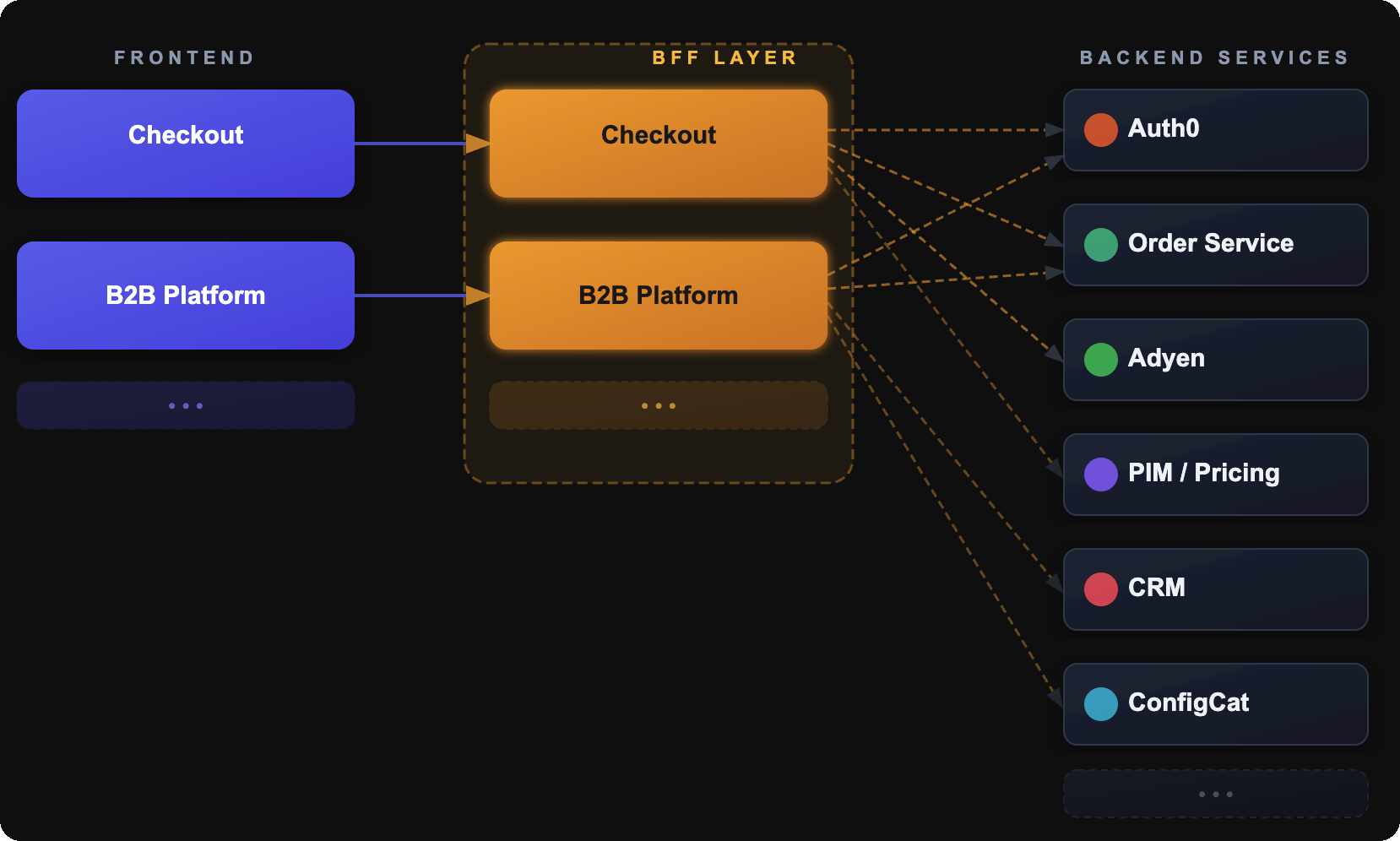
As Holafly kept growing, it decided to bring its commerce in-house and asked us to take on a brand-new B2B platform, working shoulder to shoulder with its in-house IT backend team. On the new platform, we own the entire frontend and the BFF (Backend-for-Frontend), the layer that sits between the user-facing apps and Holafly's constellation of backend services, orchestrating the calls behind the scenes so each frontend stays simple while the ecosystem behind it stays as rich as the business requires.
We also embedded into one of Holafly's engineering squads rather than sitting off to the side as an external vendor, helping them adopt Scrum in earnest to the point where the squad became a reference example for other teams in the company. We grew our involvement from two full-time engineers to three, supported by a tech lead and a project manager.
Tech stack
The technologies we used across the legacy and new platforms
Shopify headless (Remix & Hydrogen)
The frontend stack behind the legacy B2B storefront we inherited, stabilised, and are gradually retiring.
Python & AWS Lambda
The serverless backend behind the legacy platform: Lambda, SQS, DynamoDB, S3, API Gateway and CloudWatch.
Node.js & Express
The BFF (Backend-for-Frontend) layer we own on the new B2B platform, orchestrating calls to Holafly's backend services.
Auth0 & Adyen
Authentication and payments for the new platform, two of the services the BFF talks to.
PIM, Pricing & CRM
Product, pricing and customer data services orchestrated by the BFF, alongside an Order Service.
Swagger, Jest & ConfigCat
API documentation, automated testing and feature flagging: the foundations the new platform is built on.
Impact
In December 2025, we deployed the new B2B platform. Since then we have kept evolving it, shipping the features that let Holafly move its business off Shopify piece by piece rather than in one risky leap.
That gradual approach is the point. Every feature we add to the new platform is another reason for a customer to transition smoothly, with no disruption to the experience they rely on. Before the end of 2026, Holafly will have fully retired the old Shopify platform, replaced entirely by the in-house system we have been building together. A migration of that size, done without breaking the day-to-day business of a company this large, is the kind of quiet success we are proudest of.
Taken together, the outcomes speak to the scale of what is at stake.
The through-line of this whole engagement is adaptability. We came in to fix a Shopify project and ended up helping architect its replacement. We came in as an agency and ended up as an embedded squad helping shape how the whole engineering organisation works. None of that was in the original brief, and that is exactly the point.
Supporting a hyper-growth scaleup is not about executing a fixed plan flawlessly. It is about being the steady, capable partner who can absorb the shaky code, the urgent tasks, and the mid-flight change of direction, and turn all of it into something solid. A year in, Holafly is close to leaving its legacy platform behind for good, and we are still right there in the squad, building what comes next.
Key wins
Platform stability
Uptime rose significantly, edge-case incidents dropped sharply, and delivery velocity climbed.
New BFF platform
An in-house BFF now integrates five-plus backend services for the new B2B platform.
Team growth
The team grew from two to three full-time developers, plus an embedded tech lead and PM.
Migration on track
A full commerce migration is on track to finish within a single year of the decision.
Challenges
Working in a shaky codebase has a particular rhythm to it. Anything you open tends to create a butterfly effect, where a small change cascades into a handful of new issues. So every task demanded extensive investigation before a single line was written, then careful implementation, then a testing effort made harder by the absence of a staging environment and error logs. On top of that steady work sat a constant stream of genuinely urgent tasks that needed immediate attention, often arriving faster than any roadmap could absorb, and without clear prioritisation guidelines to sort them.
Our approach was to bring order to the chaos rather than to fight it. We treated stabilisation as the product. We took over the mess methodically, reduced the surface area for new breakages, and only then started adding value on top.
Then, as Holafly kept growing, the project itself changed direction. Rather than keep investing in a third-party Shopify build, the company decided to bring its commerce in-house and run its own B2B platform on its own infrastructure. We went from stabilising an inherited system to helping define the foundations of a new one, working shoulder to shoulder with Holafly's in-house IT backend team.
Let's work together
We work with a select number of clients each year. Let's see if there's a fit.
Schedule a call