EU Scream
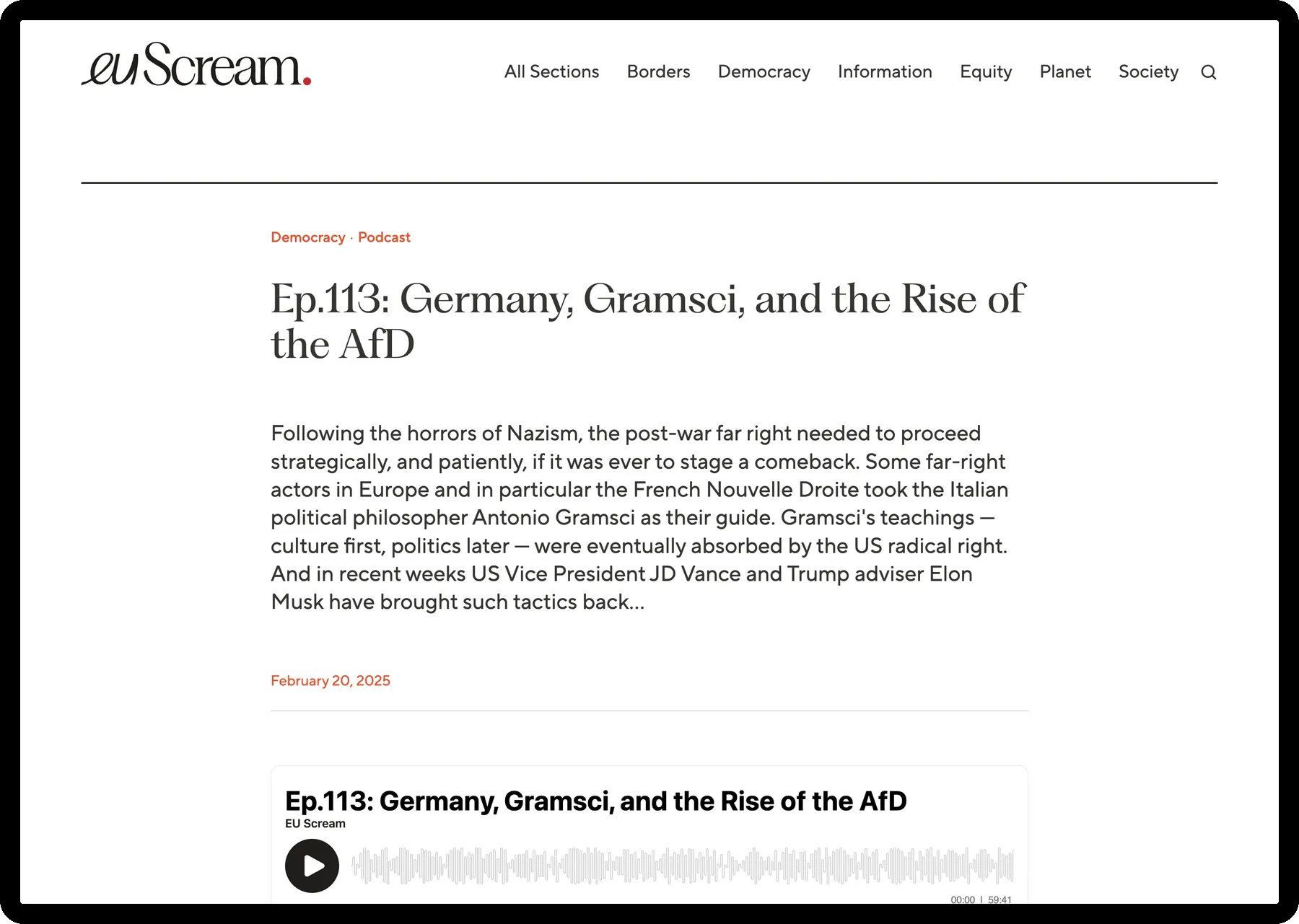
EU Scream is a not-for-profit progressive politics news-journal based in Brussels. Pro-European but critical of the institutions, it looks at how populists and extremists are shaping Europe's future, and at disinformation and its victims. Its podcast has 135+ episodes across six sections, alongside articles, opinion and a newsletter.
What did we do?
The client needed a newsroom back office for a small editorial team (reporters and editors) to plan, write, review, publish and promote content, plus a public site they could edit themselves. MarsBased migrated them from their previous WordPress site to a custom platform: existing podcast episodes were imported into the new CMS, with a new domain and public site. The new platform combines a custom newsroom CMS in Rails (Turbo/Stimulus) with a public site on Maglev (a section-based CMS) built with ViewComponents.
Editorial workflow: a reporter or editor opens a draft and a Google Doc is created automatically via the Drive API; then come writing, editor review, and the reporter setting the publish date.
Rich-text editor: includes an Unsplash integration for stock photos.
Concurrent-edit lock: built with Redis (per article/user keys, 10s expiry, 5s polling) so two editors never overwrite each other.
Social media scheduling: Twitter and LinkedIn company page posts, with LinkedIn tokens stored in the database and auto-renewed, plus a CMS warning before expiry.
Newsletter: creation, management and delivery via the Mailchimp API (segments, campaign webhooks), later reworked to support any send day, images, embeds and subscriber import.
Public search: built with
pg_search(weighting, prefix and stemming, with no extra PostgreSQL extensions).Content model: authors, multi-category articles, ads, podcasts, sitemap and OG tags, and dynamic Maglev pages for category, article and author.
Security: 2FA with
devise-two-factorand Rails encrypted credentials per environment.
Tech stack
The technologies we used in this project.
Rails
Custom newsroom CMS in Rails (Turbo/Stimulus).
Maglev
Public site on Maglev (section-based CMS) with ViewComponents.
PostgreSQL
Public search with pg_search (tsearch only): weighting, prefix, stemming.
Sidekiq & Redis
Background jobs with Sidekiq + sidekiq-cron, and Redis for the concurrent-edit lock.
Integrations
Google Drive, Twitter, LinkedIn, Mailchimp, Unsplash and Mailgun.
Infrastructure
Docker, GitHub Actions and Render, with uploads on S3 + CloudFront.
Impact
The platform launched and has been in production since late 2023, running continuously until the 2026 handover. Journalists publish end-to-end from one tool:
Open a draft, with its Google Doc created automatically.
Send it to editor review.
Set the publish date.
Schedule the social posts.
Send the newsletter.
It was also built to last: it went through a rebrand in 2025 without rewrites (logos, domains, dates, contact), and in October 2026 it was fully transferred to the client's developer.
The project also left reusable learnings for MarsBased:
Rails encrypted credentials.
2FA with Devise.
pg_searchwithout extensions.LinkedIn and Twitter publishing.
The Mailchimp integration.
Key wins
Live since 2023
Launched in late 2023 and running continuously until the 2026 handover.
One tool, end to end
Journalists publish from draft to Google Doc, review, publish, social posts and newsletter.
Rebrand without rewrites
Rebranded in 2025 without rewrites (logos, domains, dates, contact).
Fully transferred
Handed over in October 2026 to the client's developer, who now runs it on their own hosting.
Challenges
The first challenge was mapping a real newsroom workflow (roles, states, review, scheduling) into a CMS without over-engineering it, so we built it incrementally with the project manager. Concurrent editing by several journalists was another, solved with the Redis-based lock.
Third-party integrations were the most unpredictable part, with weak or changing APIs: Twitter (permissions, token regeneration, v1.1 vs v2 for media), LinkedIn (organisation scope, content-manager requirement, token expiry), Mailchimp (all-or-nothing send status and an unreliable campaign webhook, solved with a polling fallback) and a Google Drive service account.
On security, combining database_authenticatable and two_factor_authenticatable in Devise is a known security pitfall, because Warden chains the strategies. It needed careful strategy setup and db:encryption:init. On the public side, Maglev section editor errors can be hard to trace (500s or JS errors), so we used ViewComponent inheritance to keep sections maintainable, and reused the header and footer from an earlier MarsBased project.
Finally, the platform needed three years of maintenance (a rebrand and dependency updates) on a tight budget, so we kept the stack boring and the deploy path scripted. At handover, shared infrastructure was the hard part, not the code. We also prepared a minimal-effort migration branch (MinIO in docker-compose, plus a README) so the client's freelancer could run it locally.
Let's work together
We work with a select number of clients each year. Let's see if there's a fit.
Schedule a call