

Board meetings are something a lot of people are scared of. We love them at MarsBased for two reasons: first, we have no investors nor any external shareholders and secondly because it's another excuse to meet with my two best friends, who happen to be my co-founders.
Creating a business with friends is a double-edged sword for many reasons, but one that affects board meetings is that oftentimes we arrived to the meeting extremely unprepared. Last-minute things popped up, or we thought we'd have time after wrapping up this or that project. The reality is that we rarely arrived the three of us completely prepared.
Even with the best intentions, we often walked into the meeting with surprise topics on the table. Sometimes it was a new idea I'd come up with, sometimes it was a conflict between employees, or god-knows-what. The result was often the same: long, exhausting meetings and discussions that drifted all over the place, or lots of reports being presented that could've been shared before the meeting.
A couple of years ago, we decided to change that. The tool we already used daily to run the company turned out to be the answer: Linear.
At MarsBased, Linear is our operating system. We use it to manage all our development projects. But we also use it for sales pipelines, editorial content planning, hiring processes, and company-wide initiatives. Once you stop thinking of Linear as a dev-only tool and start seeing it as a structured thinking space, it becomes extremely powerful.
In fact, when we replaced Basecamp with Linear in 2022, we sort of foresaw this was going to happen. And I admit that I missed the forum-like discussions we had on Basecamp. Long format communication feels more natural to Basecamp than it is to Linear, but we couldn't have two tools for that, so we decided to give it a try anyways, and all of our asynchronous conversations happen there: company-wide announcements, news, internal memos, and more.
Preparing board meetings there felt like a natural next step.
The board meeting template
We run quarterly and annual board meetings with the three co-founders. To prepare them, we created a simple but strict template in Linear.
Each major topic gets its own card. Finance, sales, technology, AI initiatives, team, vendors or any other relevant strategic area. Every card has a clear owner. We call that person the champion of the initiative.
For example:
- Finance is owned by Jordi (COO).
- Technology and AI by Xavi (CTO).
- Sales and Marketing by me (CEO).
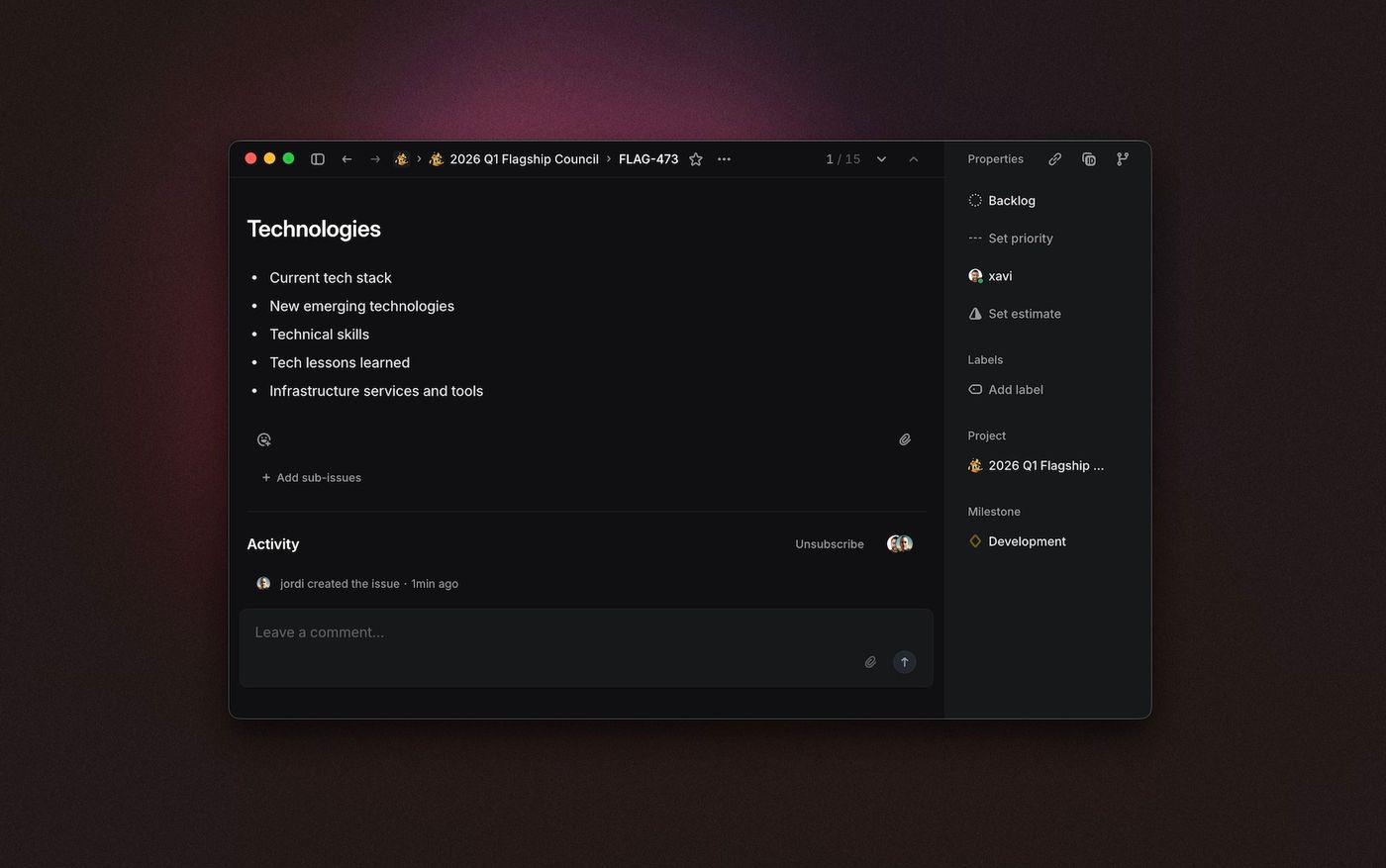
The responsibility of the champion is very clear: write the first complete draft of everything that needs to be reported or discussed. KPIs, context, concerns, open questions, and proposals all go into that card. And then, the other two people comment and discuss the topic at hand.
Asynchronous discussions before the meeting
Once the first draft is there, that's when the ball begins to roll.
Instead of waiting for the meeting, we comment directly on the cards. These are not short comments. They are often long, thoughtful, and sometimes challenging. We disagree, ask questions, and even resolve entire topics asynchronously.
By the time we meet in person, everyone has already read everything. In many cases, the discussion is already half done. Some agenda points can even be removed entirely because there is nothing left to debate. On some occasions, we've completed over 50% of the agenda topics, so we can focus on those that require in-person deeper debate.
The meeting stops being a reporting session and becomes what it should be: a decision-making space. We focus more on meeting halfway through for decisions where we've taken opposite stances or where we have to disagree and commit.
Do's and don'ts
A tool doesn't usually fix a broken system but in this case it helped greatly.
The peer pressure of seeing that your co-founders have sent their reports and insights two weeks before the meeting might prod you to work on yours. Whereas before you wouldn't know if you were the only one to not prepare the meeting, now you can see it. And they can see you.
This social accountability works like a charm but it is not 100% bulletproof. There'll be topics arising in the 48h prior to the meeting, or maybe one of us is overworked and can't really prepare properly. While not perfect, this system has helped us to do a better job overall in 95% of the cases, and that is worth it.
We could refine it and add a strict deadline of "everything has to be sent one week before the board meeting" and we would perhaps go up from 95% to 98% but I don't know if it's worth it, at this point in time.
We could also add the equivalent of a code freeze and do a "topic freeze". No new topics can be added one week prior to the board meeting, but I don't think we need it now. Maybe it works for bigger companies, though.
Since we implemented this approach, board meetings are shorter, calmer, and far more productive. There are no surprise topics. Sensitive issues surface early, in writing, and with context. Everyone arrives prepared and that contributes to lower cortisol levels during these meetings, which is a key ingredient to having a long-lasting lifestyle business like MarsBased.
Artículos relacionados

We've adopted Linear for project (and company) management!
At MarsBased, we like to review our workflows, tools and policies every now and then because what it used to be good for us, might not be the right fit now. For instance, last year, we changed our project management tool from JIRA to Linear.
Leer el artículo
How to manage expectations in software projects
Business thrives on flexibility. We share six practical tips, from asking ‘why?’ to daily feedback, that shape our approach at MarsBased. Simple, insightful, and with some fun gifs - why not?
Leer el artículo
Here's how we use Basecamp to manage our teams remotely
We've been using Basecamp 3 for a while now, and it really fits our company culture of having no office.
Leer el artículo